Texas County Crime Analysis
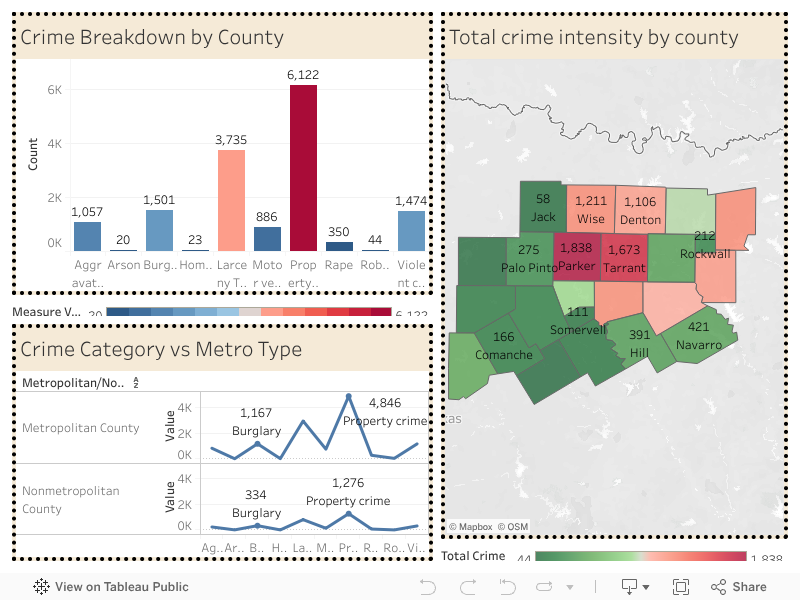
The dashboard provides a comparative analysis of crime distribution across 24 counties in Texas, segmented by crime type, county, and metropolitan classification (Metropolitan vs Nonmetropolitan).
It visualizes the volume, intensity, and geographical spread of crimes, enabling law enforcement and policymakers to identify key hotspots and evaluate the relative safety of rural vs urban regions.
Key Insights
- Highest Crime Categories:
- Property Crime dominates with 6,122 incidents, followed by Larceny-Theft (3,735) and Burglary (1,501).
- Violent crimes (1,474 cases) are primarily driven by aggravated assault and robbery.
- Top Counties by Crime Intensity:
- Parker (1,838) and Tarrant (1,673) counties show the highest total reported crimes.
- Other high-incidence counties include Wise (1,211), Hunt (1,208), and Johnson (1,194).
- Hamilton (44) and Stephens (52) report the lowest crime levels.
- Metropolitan vs Nonmetropolitan Comparison:
- Metropolitan counties exhibit significantly higher crime volumes.
- Example: Property crimes in metropolitan areas (4,846) are nearly four times greater than those in nonmetropolitan counties (1,276).
- Violent and theft-related crimes are also more prevalent in metro regions due to higher population density and urbanization.
Demographics and Statistical Context
- Region: North Central Texas (24 counties, including Dallas, Tarrant, Collin, Denton, Parker, Johnson, etc.)
- Classification: Counties grouped into Metropolitan (urban) and Nonmetropolitan (rural) categories.
- Crime Categories Analyzed:
Aggravated Assault, Arson, Burglary, Larceny-Theft, Motor Vehicle Theft, Homicide, Property Crime, Rape, Robbery, Violent Crime. - Statistical Range:
- Total Crime Count per County: 44 (min) to 1,838 (max).
- Metro Counties contribute to over 80% of total reported incidents.
- Property crimes account for nearly 55–60% of total recorded offenses across all regions.
Interpretation
- Urban Influence: Higher concentration of crimes in metropolitan counties aligns with increased population, economic activity, and reporting infrastructure.
- Rural Stability: Nonmetropolitan areas maintain lower crime rates but show isolated instances of property and vehicle theft.
- Policy Insight: Targeted safety interventions, property surveillance initiatives, and awareness programs could mitigate crime intensity in identified hotspot counties.